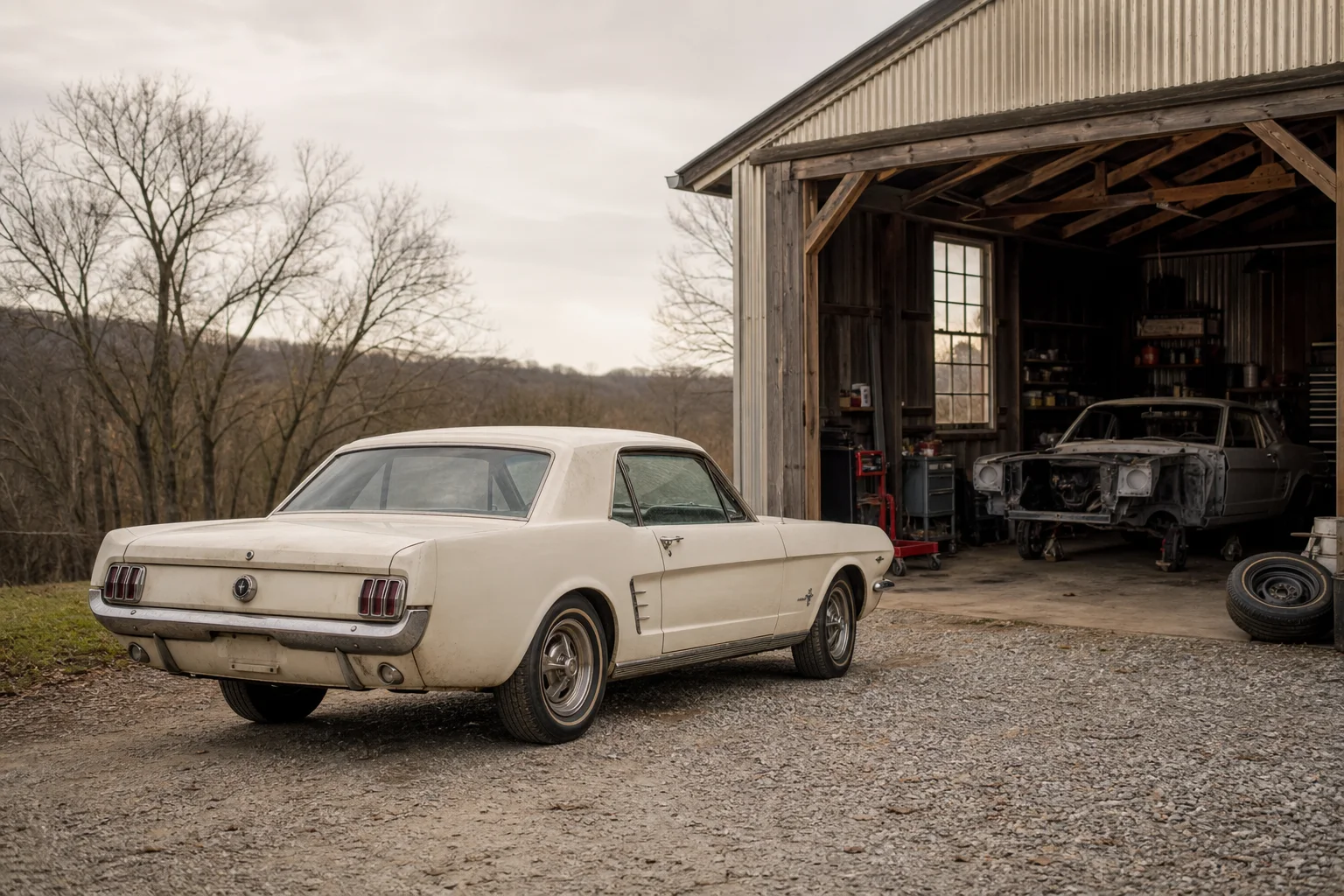
The most useful Mustang history for owners is the one that explains why the cars were engineered the way they were—and what that means when you restore, preserve, and authenticate them today.
The Ford Mustang’s most useful history is not the familiar parade of badges and horsepower claims. It is the story of a nameplate that repeatedly saved itself by changing shape, scale, and engineering philosophy to match the moment, without breaking the emotional contract that makes a Mustang a Mustang. For owners and restorers, that push-pull explains nearly every practical reality of the cars today: why early bodies rot the way they do, why certain years are option-minefields, why emissions-era cars demand a different kind of patience, and why later Mustangs have such deep parts support compared with other performance cars.
The first Mustang was born from constraint, not extravagance. Inside Ford, the “Special Falcon” program pitch made clear that the car’s appeal would come from proportions and styling details that read expensive, while the underlying investment stayed disciplined by leaning on existing compact-car fundamentals.[1] Museum and corporate history accounts converge on the key decisions: Lee Iacocca championed the concept, and Hal Sperlich’s crucial move was to base the car on Falcon bones to keep cost and timing under control.[2] Ford staged the reveal at the New York World’s Fair, with press previews in mid-April 1964 and public release on April 17, 1964, turning a pragmatic platform exercise into a cultural event.[3]
That origin story matters in the shop because it predicts the early car’s personality. A unibody built to hit a price point can be durable, but it is rarely indifferent to rust, old collision repairs, or decades of shortcut modifications. In preservation terms, the early Mustang is a masterclass in why original seam sealing, drain paths, and correct panel fit are not cosmetic trivia. When those basics are wrong, the car will telegraph it later as door sag, stress cracks, water ingress, and the familiar corrosion patterns that show up after a few seasons of real use.
The Mustang’s immediate success created a second problem: what happens when the inexpensive sporty car becomes, almost overnight, the canvas for every buyer’s fantasy. Ford itself emphasized the scale of the launch and the speed with which Mustang became the center of a massive merchandising and marketing effort.[3] From a restoration standpoint, this is why documentation culture grew up around Mustangs earlier than it did for many contemporaries. For 1967-and-later cars, Marti Auto Works holds Ford’s licensed production database and can generate reports tied to a specific serial number, which is now a baseline tool for confirming how a particular car was ordered and built.[4] The practical implication is blunt: when a car’s market identity can swing on a code or option combination, the smartest restorations start with paperwork and physical verification before parts get ordered and paint gets mixed.
Racing and performance variants added a second layer of complexity. The 1965 Shelby GT350 program is a good example of how quickly the Mustang became more than a Ford assembly-line product. The Shelby American Collection documents how Ford shipped incomplete fastbacks to Shelby in late 1964 so that Shelby could complete the GT350 conversions, and it also notes the need to build enough street-legal examples to qualify for SCCA production racing.[5] For today’s owners, the takeaway is less about hero stories and more about forensic reality: early competition-derived cars often contain period-specific modifications, running changes, and parts sourcing quirks that don’t behave like standard catalog restorations. Restoring one correctly is closer to conserving an artifact than rebuilding a “spec” car.
By the early 1970s, the Mustang faced pressures that were bigger than any one model year. Federal regulation increasingly shaped what cars looked like and how they were engineered. NHTSA’s own documentation on bumper standards explains how the first federal bumper requirements arrived for cars manufactured after September 1, 1972 (the start of the 1973 model year) and became more stringent for 1974 and later model years, with escalating requirements that influenced design, weight, and cost.[6] On the emissions side, the EPA’s timeline of transportation air-pollution control underscores how the Clean Air Act era pushed dramatic reductions in new-car emissions and brought unleaded gasoline into the mainstream to protect catalytic converters.[7]
This is the backdrop for the Mustang II: a car that tends to be judged as an affront when it should be read as a survival strategy. The second-generation Mustang arrived for the 1974 model year in the same general period as the fuel crisis and amid tightening emissions and safety expectations.[8] Whatever one thinks of the styling, the functional point is that Ford sized the car to the market it actually had, not the market enthusiasts wished they still had. From a restoration angle, these cars reward realism. You restore a Mustang II best by leaning into what it is: lighter, smaller, and engineered to meet the rules of its day. Chasing an anachronistic feel often leads to drivability compromises, overheating, or ill-sorted fuel and ignition calibrations that can turn a pleasant cruiser into a frustrating project.
In the late 1970s, Ford performed one of the most consequential resets in the Mustang’s history: the Fox platform era. Ford’s own heritage-vault materials for the 1979 Mustang position it as a “whole new breed” for that model year, signaling a clean break from the Mustang II’s underpinnings.[9] Independent historical references align that 1979 marked a complete redesign onto Ford’s new Fox platform.[10]
For restorers and collectors, the Fox-body years are where the Mustang becomes unusually serviceable as an old performance car. Parts interchange across trims and years is broad, drivetrain swaps became culturally normalized, and the aftermarket grew up alongside the cars rather than arriving decades later. This is also why documentation and authenticity tools matter so much: Fox cars are easy to modify well, and just as easy to misrepresent. Here the Marti ecosystem becomes especially relevant again because it can anchor a car’s as-built identity for 1967–2017 model years, including Fox-era vehicles.[4] The best restorations of Fox cars are clear-eyed about intent: either preserve a true survivor with correct finishes and hardware, or build a coherent driver where every change has a functional rationale and is executed cleanly.
The 1994 redesign, known popularly as SN95, is often described as a new generation, but the deeper story is continuity disguised as change. Ford substantially reworked the architecture that began with Fox, a fact reflected in references that describe the 1994 update as a major redesign built on an evolved Fox structure.[11] For preservation customers, SN95 cars offer an appealing middle ground: they can deliver modern-enough comfort and parts availability while still living close to the mechanical logic that makes Fox-body ownership so straightforward. The restoration implication is that corrosion prevention and structural integrity checks remain essential, but the day-to-day usability ceiling is higher than on earlier cars without requiring you to step into the diagnostic and module complexity of later models.
In 2005, Ford leaned hard into heritage cues with the fifth-generation Mustang, introduced as a redesigned model for the 2005 model year and tied to a new platform program.[12] This is the moment when “restoration” and “preservation” begin to merge with “stewardship.” Owners are increasingly caretakers of cars that were engineered with modern crash structure, tighter manufacturing tolerances, and electronics that will someday require their own preservation mindset. The shop reality is that maintaining an early S197 Mustang’s originality often means planning ahead for interior plastics, coatings, and trim pieces that age differently than 1960s materials.
The modern pivot with the clearest mechanical meaning is 2015, when Mustang went global in a way earlier generations had not, and Ford’s media materials explicitly framed it as the first-ever global launch of the car.[13] More important for how the cars drive and how they age: Ford moved to fully independent rear suspension across the line for 2015, a long-discussed step that changed the handling character and the underbody layout in ways that show up on a lift as much as on a back road.[14] For preservation owners, this is where alignment, bushing condition, and correct subframe mounting torque become central to keeping the car feeling “right,” and where a careful eye for impact damage matters even more because suspension geometry is less forgiving than a live-axle setup.
Across all of these pivots, the Mustang’s through-line is not a single engine family or a fixed body shape. It is the willingness to use mainstream components when needed, then wrap them in proportions and branding that keep the promise of a sporty, personal car. That is why the earliest Mustangs reward meticulous unibody and water-management work, why Shelby-era cars demand documentation discipline, why Mustang II restorations work best when they respect the era’s constraints, and why Fox and later cars thrive when authenticity and intent are decided before the first wrench turns.
The Mustang’s history is, in practice, a guide to choosing the right kind of restoration for the car you actually own.
Sources
- Operating Policy Committee Special Falcon Program presentation (Iacocca) — Lincoln / Ford Media (history archive PDF)
- Mustang: The Birth of an American Icon — The Henry Ford
- Mustang Debut at World’s Fair — Ford Motor Company (Corporate)
- Marti Auto Works – Marti Report (official description) — Marti Auto Works
- 1965 Shelby Mustang GT350 — Shelby American Collection
- Evaluation of the Bumper Standard (publication executive summary) — National Highway Traffic Safety Administration (NHTSA)
- Timeline of Major Accomplishments in Transportation, Air Pollution, and Climate Change — United States Environmental Protection Agency (EPA)
- Ford Mustang (second generation) — Wikipedia
- 1979 Ford Mustang heritage-vault document (AR-96-212010-18071) — Ford Heritage Vault (Ford)
- 1979 Ford Mustang — Complete Reference — The Foxbody Archive
- Ford Mustang (fourth generation) — Wikipedia
- Ford Mustang — Wikipedia
- Ford Mustang: World’s Best-Selling Sports Car in Early 2015; Production Begins on Right-Hand-Drive Model — Ford Media Center (Canada)
- Ford Announces Power Outputs for All-New Mustang; Lightweight Body and Performance Chassis — Ford Media Center (Great Britain)
AI-assisted research, reviewed and approved by Exclusively Classics.