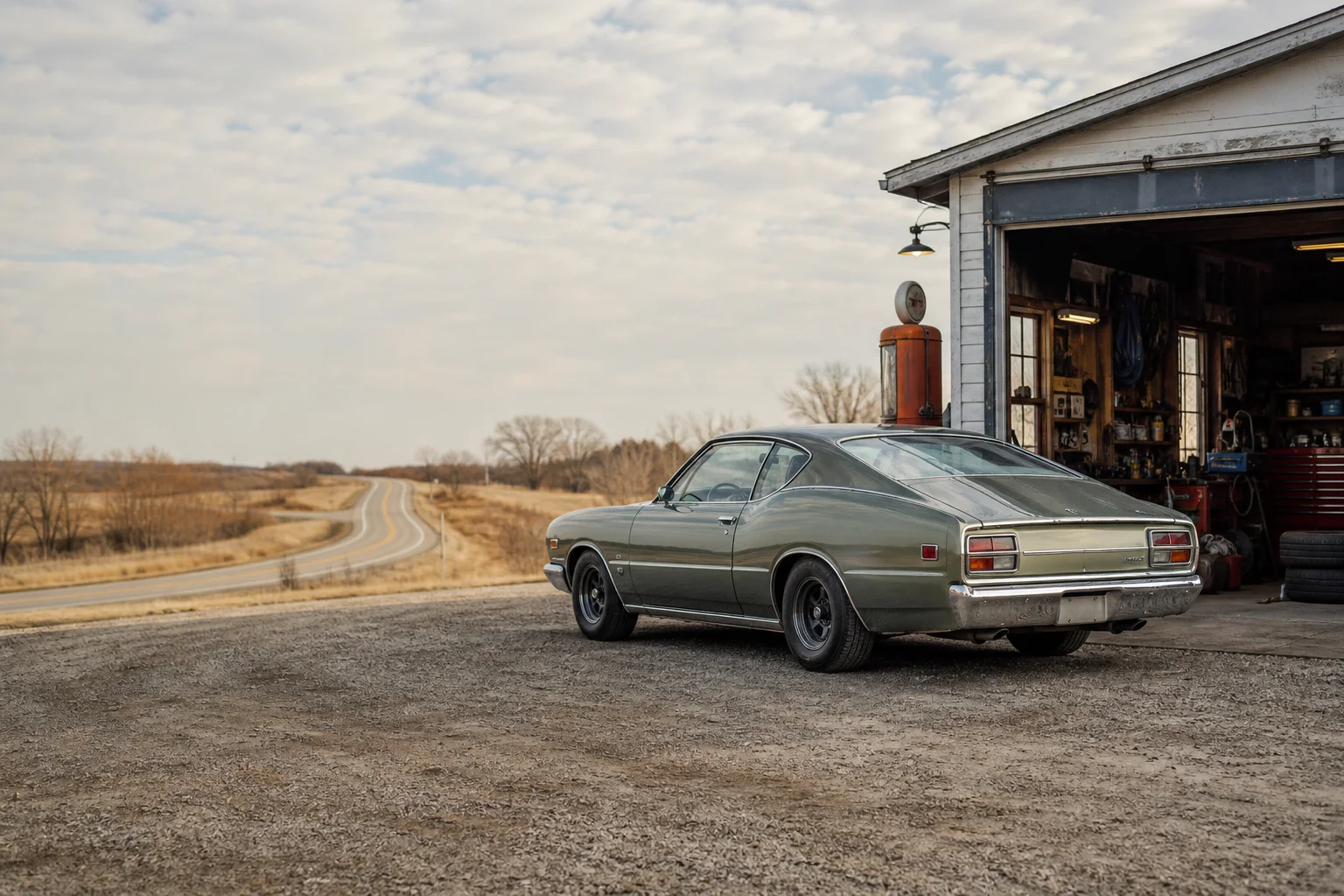
Classic cars stay popular because they’re artifacts from the era when driving became a national habit—and because the collector market rewards workmanship, documentation, and condition in ways modern consumption rarely does. From postwar miles traveled to 1970s emissions rules, history and economics shape what owners preserve and what restorers must do right.
Classic cars never really “came back,” because they never really left. What has changed is the world around them. In a century defined by scale, regulation, and rapid product churn, the old-car hobby has become an unusually durable way for owners to hold onto something the modern economy tends to erase: a machine with a readable story, a finite parts ecosystem, and a value that is set as much by culture as by catalog. That popularity is easiest to understand from two angles that restoration customers live every day. The first is historical: the automobile’s role in American life expanded at a pace that’s hard to fathom now, and the cars we call “classics” are physical artifacts from the period when driving became a national habit. The second is economic: classic cars occupy a small, idiosyncratic market that runs on scarcity, taste, and trust, and the shop choices that preserve history also preserve liquidity. Start with the basic fact of use. Federal Highway Administration data show U.S. vehicle-miles traveled climbing dramatically over the long arc from the prewar era through the postwar decades, with growth continuing into the modern era.[1] The collector car, in other words, isn’t merely a product; it’s a souvenir from the moment the country reorganized itself around mobility. That’s why certain cars remain culturally “loud” even to people who don’t own one: they are tied to the lived experience of travel, courtship, work, and weekend freedom. That historical pull gets stronger as modern cars become harder to read. The classic era offers mechanical legibility: carburetors that can be tuned by ear, distributors that reveal their logic, sheetmetal that can be cut and re-made instead of replaced as a sealed module. Even for owners who rarely turn a wrench, the appeal often rests on the sense that the car’s operation can be understood. In a restoration shop, that translates into a practical truth: customers are paying not just for cosmetic resurrection, but for restored intelligibility—systems that behave the way their original engineers intended. Economics enters as soon as the conversation turns from “love” to “life.” A collector car is a discretionary purchase that competes with other stores of value, and people compare it—fairly or not—to financial benchmarks. The enduring public presence of stock indices like the Dow Jones Industrial Average, first published in 1896, is part of the cultural backdrop that trained generations to track value over time.[2] Collectors don’t need to be traders to think in that language; they simply live in an economy that constantly quantifies performance. But classic cars don’t behave like stocks, and the market’s infrastructure has evolved accordingly. Hagerty’s valuation tools and related market reporting explicitly treat the collector-vehicle marketplace as its own ecosystem, emphasizing condition definitions and the need to interpret sales data within the realities of originality, presentation, and buyer intent.[3] That perspective matters at the shop level because it aligns with what restoration veterans already know: two cars that are “the same model” can be different assets depending on provenance, build choices, documentation, and whether the work respects how the market defines condition. The historic and economic stories intertwine most clearly when regulation changes the meaning of “old.” The 1970 Clean Air Act set in motion a new era of emissions control, and by the mid-1970s catalytic converters were broadly installed on most 1975-and-newer passenger cars and light-duty trucks to meet federal standards.[4] The EPA also tied emissions compliance to maintenance expectations, including requirements for warning systems on 1975-and-later cars related to emissions-control components.[5] This is more than a policy footnote. It marks a dividing line in the restoration world: pre-catalyst cars represent one mechanical philosophy; catalyst-era cars represent another, with different tuning windows, exhaust layouts, and compliance considerations. That regulatory arc contributes to classic-car popularity in two opposite ways. On one hand, it creates nostalgia for the pre-regulation driving experience—the sound, the smell, the immediacy of throttle response in a simple engine bay. On the other, it makes certain “newer classics” compelling precisely because they sit at the hinge point: early emissions technology, transitional electronics, and drivability that begins to resemble modern expectations. From a preservation standpoint, those transition cars can be deceptively difficult. Parts availability may be uneven, and the temptation to simplify—removing equipment that was engineered into the car—can conflict with how value is judged later. This is where the economics becomes practical. A restoration budget is always finite, and value is never guaranteed. Hagerty’s own consumer-facing guidance cautions that valuation information should be used to understand the market, while leaning on expertise and judgment rather than treating numbers as certainty.[3] That maps neatly onto best practice in a professional shop: build a plan around the owner’s intended use and the car’s inherent significance, not around a single optimistic price point. Three shop-floor implications follow from that historical-economic lens. 1. Documentation is a value multiplier because it connects the artifact to its time. The postwar growth of driving and travel is not just an abstract trend; it’s the backdrop against which a specific car lived.[1] Service records, old registrations, window stickers, photos, and period accessories make a vehicle’s history legible. Even when the work is mechanical, the story matters because it supports future stewardship. 2. Condition language is not cosmetic; it is market structure. Collector valuations hinge on condition definitions and on the reality that the market behaves differently than ordinary used-car commerce.[3] In practice, that means “fresh paint” is not the same as correct paint; “rebuilt” is not the same as properly engineered. The owner who understands those distinctions tends to commission work that ages well, both materially and economically. 3. Emissions-era choices can age into liabilities or assets. The Clean Air Act timeline and the widespread adoption of catalytic converters in 1975-and-newer vehicles created a new baseline for what “correct” means in many jurisdictions and in many buyer communities.[4] The preservation-minded approach is to retain, refurbish, or correctly replace emissions-related components where feasible, and to document any deviations honestly. That is less about virtue and more about avoiding future friction when the next caretaker evaluates the car. The larger reason classics remain popular, though, is cultural economics: the hobby rewards patience and discernment in a way modern consumption rarely does. Most products are designed to be replaced; a good restoration is designed to be maintained. That maintenance mindset is not incidental. The EPA’s maintenance-related framing for emissions-controlled vehicles, for example, is a reminder that regulation assumed ongoing care as part of the ownership contract.[5] Collectors, meanwhile, apply the same logic even when they’re dealing with pre-regulation cars: the machines survive on regular attention. There’s also an underappreciated macroeconomic point hiding in plain sight. In times when people feel that “everything changes,” they gravitate toward objects with stable identities. The Dow’s century-plus continuity as a widely referenced index is one example of a culture that prizes benchmarks across generations.[2] Classic cars function as a different kind of benchmark: a tangible reference for what driving, styling, and engineering felt like at a specific moment. The more the contemporary automotive landscape shifts—whether toward electrification, software-driven features, or new regulatory targets—the more owners will seek out fixed points. Even without predicting where the market goes, the pattern is historically consistent: the artifact gains emotional weight as the present becomes less familiar. For restoration customers, the most useful conclusion is also the simplest. Classic cars stay popular because they compress history and value into something you can start, steer, and preserve. The work that keeps them alive—correct materials, careful mechanical decisions, and honest documentation—doesn’t just protect a car’s finish. It protects the reasons the car mattered in the first place.
Sources
- Relationships Between Asset Management and Travel Demand: Exhibits (Growth of VMT) — Federal Highway Administration (FHWA)
- Dow Jones Industrial Average Celebrates 130 Years as Iconic American Benchmark — S&P Dow Jones Indices
- Hagerty Valuation Tools: About Our Conditions — Hagerty
- What You Should Know About Using, Installing, or Buying Aftermarket Catalytic Converters — United States Environmental Protection Agency (EPA)
- EPA Sets Auto Maintenance Regulations (Archive) — United States Environmental Protection Agency (EPA)
AI-assisted research, reviewed and approved by Exclusively Classics.