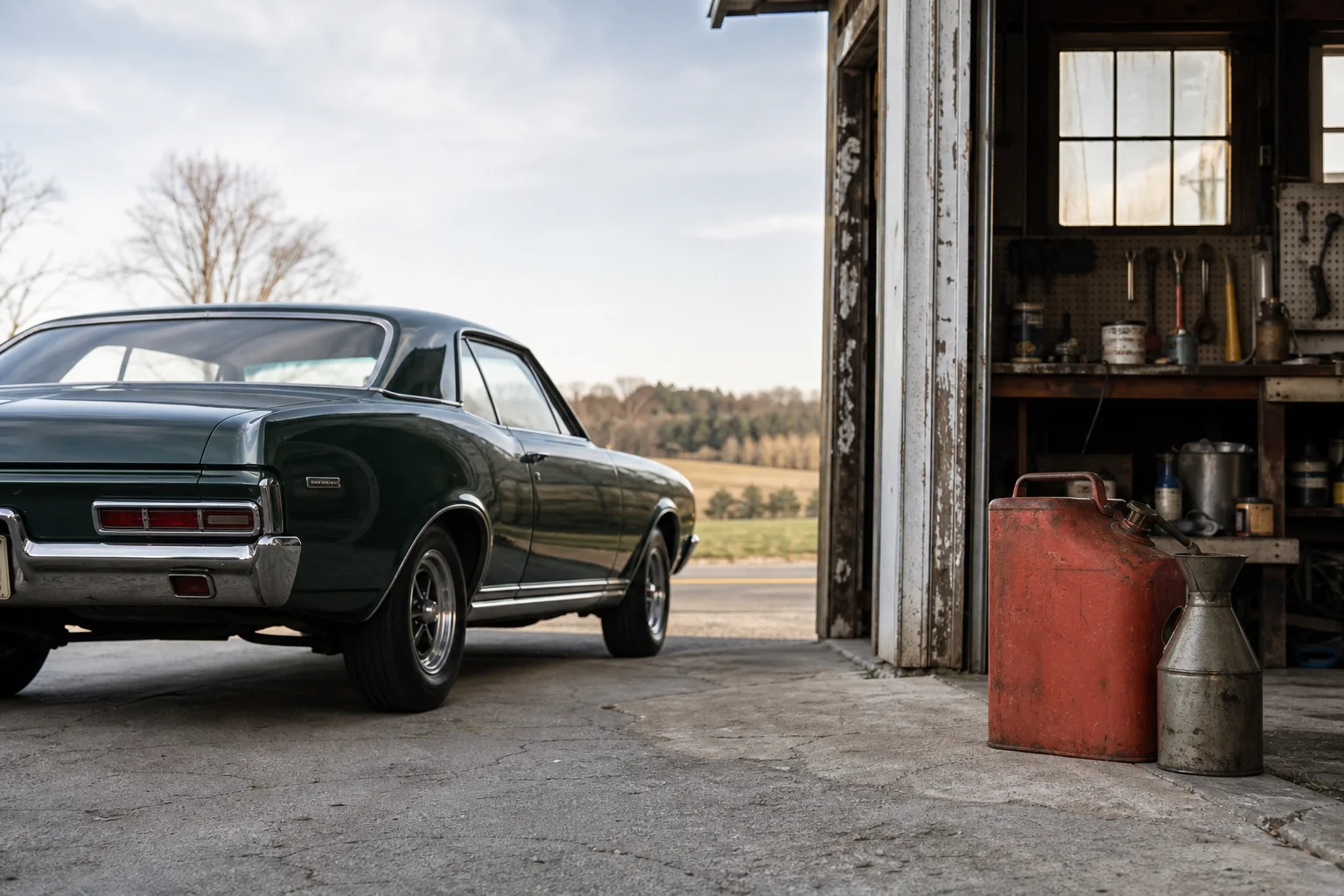
Ethanol didn’t just replace lead; it changed the solvent strength, water behavior, and volatility profile of the fuel your carbureted classic was built around. The result is predictable: old materials, dirty tanks, and long storage intervals become the weak links. Build for E10, avoid E15, and treat the fuel system as a preservation item.
Mid‑century American cars were engineered around a moving target: gasoline that varied by region and season, but that was, in day‑to‑day use, a largely hydrocarbon fuel delivered by vented tanks, steel lines, mechanical pumps, and carburetors. The modern pump is a different world. In most of the U.S., the default “gas” is now E10, and in many markets E15 is widely offered—approved by the EPA only for model‑year 2001 and newer light‑duty vehicles, with labeling and other safeguards intended to prevent misfueling older vehicles and small engines. [1] [2]
For classic‑car owners, the useful way to think about ethanol is not as a political football or a single “bad ingredient,” but as a change in fuel chemistry that exposes the weak links in vintage fuel systems: certain elastomers, some plated metals, long‑parked tanks with varnish and sediment, and storage habits that made sense when gasoline carried less oxygen and behaved differently around moisture. Studies that specifically looked at classic‑era fuel delivery hardware show measurable durability and performance effects when that older hardware is run on E10. [3] That does not mean every collector car will melt down on modern fuel. It means restoration and preservation decisions now have to assume ethanol is present unless you can verify otherwise.
The first hard distinction is blend level. E10 is the baseline nearly everywhere and is treated as ordinary gasoline in the marketplace. [4] E15 is not. The EPA’s partial waivers and its misfueling‑mitigation rule draw a bright line: E15 is allowed for use in 2001‑and‑newer light‑duty vehicles, and it is not approved for pre‑2001 cars, motorcycles, boats, and many other gasoline engines. [2] [5] That matters for classics because the biggest real‑world risk is not that E15 exists; it’s that a driver grabs the wrong handle at a station where the mid‑grade or regular option is E15, or where labeling is ignored in the rush of a road trip. The regulatory intent is explicit: mitigate misfueling of older vehicles and engines with gasoline containing more than 10% ethanol. [2]
From the shop floor, the second distinction is material compatibility. Ethanol is a strong solvent compared with the fuel environment many mid‑century components were designed for, and it behaves differently with water. When researchers put fuel‑system materials through standardized immersion and aging protocols for ethanol‑blended gasoline, they documented changes in properties of elastomers and plastics used for hoses, seals, gaskets, and other components. [6] And when older fuel delivery systems representative of classic automobiles were evaluated for performance and durability on E10, the point of the work was precisely that legacy parts and legacy material choices can respond differently than late‑model designs. [3]
In practical terms, that maps to the classic symptoms restorers see repeatedly: hoses that weep or crack early, accelerator‑pump cups that stiffen, needle‑and‑seat assemblies that don’t seal consistently, floats that don’t behave as they once did, and fuel‑pump diaphragms that suddenly seem to have “aged” a decade in one season. You can run a car like that, and some do, right up until the day it turns into a no‑start, a garage that smells like fuel, or a roadside fire risk.
Ethanol’s relationship with water is the other half of the story, and it’s where modern fuel diverges most sharply from mid‑century expectations. Ethanol is miscible with water; it will absorb and carry small amounts of moisture that older gasoline would not have held in the same way. In a vented classic fuel system—especially one that sits—temperature swings and humidity can feed that moisture cycle. Once water contamination gets high enough, the blend can separate into phases, leaving a water‑rich ethanol layer and a gasoline‑rich layer. Collector‑car media have been warning owners about phase separation and storage problems for years, and the warnings persist because the mechanism is real in the field, particularly for cars that are parked for long stretches. [7]
This is the point where the “mid‑century fuel vs. modern fuel” comparison becomes most useful. Many classic cars were happy to sit through a winter on fuel that was less aggressive as a solvent and less prone to water‑driven separation in typical storage conditions. Today, storage is not passive. If a car is laid up, the fuel system has to be treated as a preservation item.
The third divergence is volatility behavior. Ethanol changes the way a gasoline blend evaporates and distills across a temperature range, which is one reason emissions and driveability programs pay close attention to distillation curves and vapor pressure as blend levels change. [8] For carbureted classics, the lived experience shows up as hot‑start complaints, percolation in a warm carburetor, and vapor‑lock‑like behavior when under‑hood temperatures climb. Not every hot‑start issue is “ethanol,” and not every car reacts the same. But the interaction between modern blend behavior, under‑hood heat management, and vintage fuel routing is a real tuning and restoration concern.
What owners often miss is that ethanol problems are frequently restoration problems in disguise. A 60‑year‑old fuel tank with a film of old varnish and fine rust can be “stable” on a car that’s rarely driven. Introduce a fuel that is a more active solvent, and that film can start moving. Filters clog. Carburetor passages foul. The owner blames ethanol. The fuel is not innocent, but the root cause is a system that was already living on borrowed time.
A defensible shop strategy starts with acknowledging the regulatory and marketplace reality: you cannot assume ethanol‑free fuel is available on demand, and you cannot assume the driver will never encounter E15. The DOE’s Alternative Fuels Data Center is blunt about what E15 is and what vehicles it is intended for, and it reinforces that E10 remains the limit for older passenger vehicles and many non‑road engines. [1] So the build needs to tolerate E10 as a minimum, and it needs clear instructions to avoid E15 entirely.
From there, preservation divides into two tracks: make original‑type hardware survive better, or replace it with ethanol‑tolerant components while respecting the vehicle’s character.
For original‑type systems, the key is controlled compatibility. Marque organizations and historic‑vehicle federations in other markets have distilled this into simple guidance: choose seal and hose materials known to be more resistant to modern blends, and be wary of “miracle” additive claims. The Federation of British Historic Vehicle Clubs, for instance, points to fluoroelastomer materials commonly known by the Viton trade name as broadly compatible for seals, and it urges skepticism about claims of complete protection by additives. [9] That is not a parts list for every American classic, but it’s a sound principle: prioritize materials with a track record in oxygenated fuels.
For many American restorations, the most meaningful upgrade is also the least visible: modern fuel hose and pump diaphragm materials, plus careful attention to clamps and routing so the hose is not being cooked by headers or pinched by a poorly supported line. In the same category, carburetor rebuild parts matter. “Rebuilt” is not a specification. A rebuild using components that were fine in the 1990s can still be wrong for today’s fuel.
On the replacement side, tank work becomes more than cosmetic. If a car arrives with recurring filter plugging or evidence of dissolved deposits, it is often smarter to clean and rehabilitate the tank and hard lines than to keep chasing carburetor debris. When you remove the source of contamination, you also reduce the chance that ethanol’s solvency will keep stripping the system. This is where restoration budget meets reliability: spending time once on the tank, sender, pickup, and lines can prevent a long string of carburetor “mysteries.”
Storage procedure is the other lever owners control. Ethanol does not punish cars that are driven regularly and kept in a predictable fuel‑turnover cycle as harshly as it punishes cars that sit. Collector‑car outlets have long emphasized that storage fuel management is central, particularly to avoid water problems and deposit formation. [7] In practice, that means reducing the time fuel is left to age in a vented system, and treating the fuel system like any other preservation system: stable environment, clean hardware, and a plan.
It also means being honest about how a car is used. The owner who drives 2,000 miles a year and refuels every few weeks can build a different plan than the owner who starts the car twice a season and otherwise stores it. The latter use case is where ethanol’s water and solvency behaviors stack up most quickly.
Where does E15 fit into a classic‑car policy? Simply: it is not a tuning experiment. The EPA’s position is that E15 is allowed for 2001‑and‑newer light‑duty vehicles, and the agency’s rules focus on preventing misfueling older vehicles and engines. [2] [5] That makes E15 the wrong variable to introduce into an already marginal vintage system. Even for newer engines, durability testing and policy reviews have flagged that intermediate blends can create failures in certain conditions and in certain engines, which is part of why misfueling controls exist in the first place. [10]
The real‑world implication for a collector is straightforward. If a classic is on the road and the only ethanol choice is E10, build and maintain the car to live on E10. If the choice is between E10 and E15, choose E10 every time. If you encounter “Unleaded 88” or any pump that is clearly labeled E15, treat it as off‑limits. The legal and technical boundaries are not aimed at your 1965 convertible; they are aimed at preventing exactly that scenario. [2]
None of this requires nostalgia for leaded fuel or an argument that modern gasoline is universally worse. Modern fuel enables clean running in modern engines, and blend standards exist for reasons beyond the collector hobby. But the classic‑car community is living with a mismatch between old hardware and today’s chemistry. The fix is not panic, and it isn’t wishful thinking at the pump. It is deliberate material choice, clean fuel hardware, and storage habits that assume ethanol is present.
Modern fuel is not an enemy; it is a design constraint. Build for it, and the car behaves like a car again.
Sources
- E15 — U.S. Department of Energy (Alternative Fuels Data Center)
- Final Rule: Regulation To Mitigate the Misfueling of Vehicles and Engines With Gasoline Containing Greater Than Ten Volume Percent Ethanol — U.S. Environmental Protection Agency
- The Effect of Using Ethanol-blended Gasoline on the Performance and Durability of Fuel Delivery Systems in Classic Automobiles (SAE 2010-01-2135) — SAE International
- Fuel Blends — U.S. Department of Energy (Alternative Fuels Data Center)
- EPA Grants E15 Fuel Waiver for Model Years 2001–2006 Cars and Light Trucks (Jan. 21, 2011) — U.S. Environmental Protection Agency (Archive)
- Material Compatibility of Elastomers and Plastics in Ethanol-blended (E10) Gasoline (SAE 2013-26-0077) — SAE International
- Living with Ethanol — Hagerty Media
- Quantification of gasoline-ethanol blend emissions effects — Journal of the Air & Waste Management Association (Taylor & Francis)
- Fuels — Federation of British Historic Vehicle Clubs
- Biofuels: Challenges to the Transportation, Sale, and Use of Intermediate Ethanol Blends (GAO-11-513) — U.S. Government Accountability Office
AI-assisted research, reviewed and approved by Exclusively Classics.