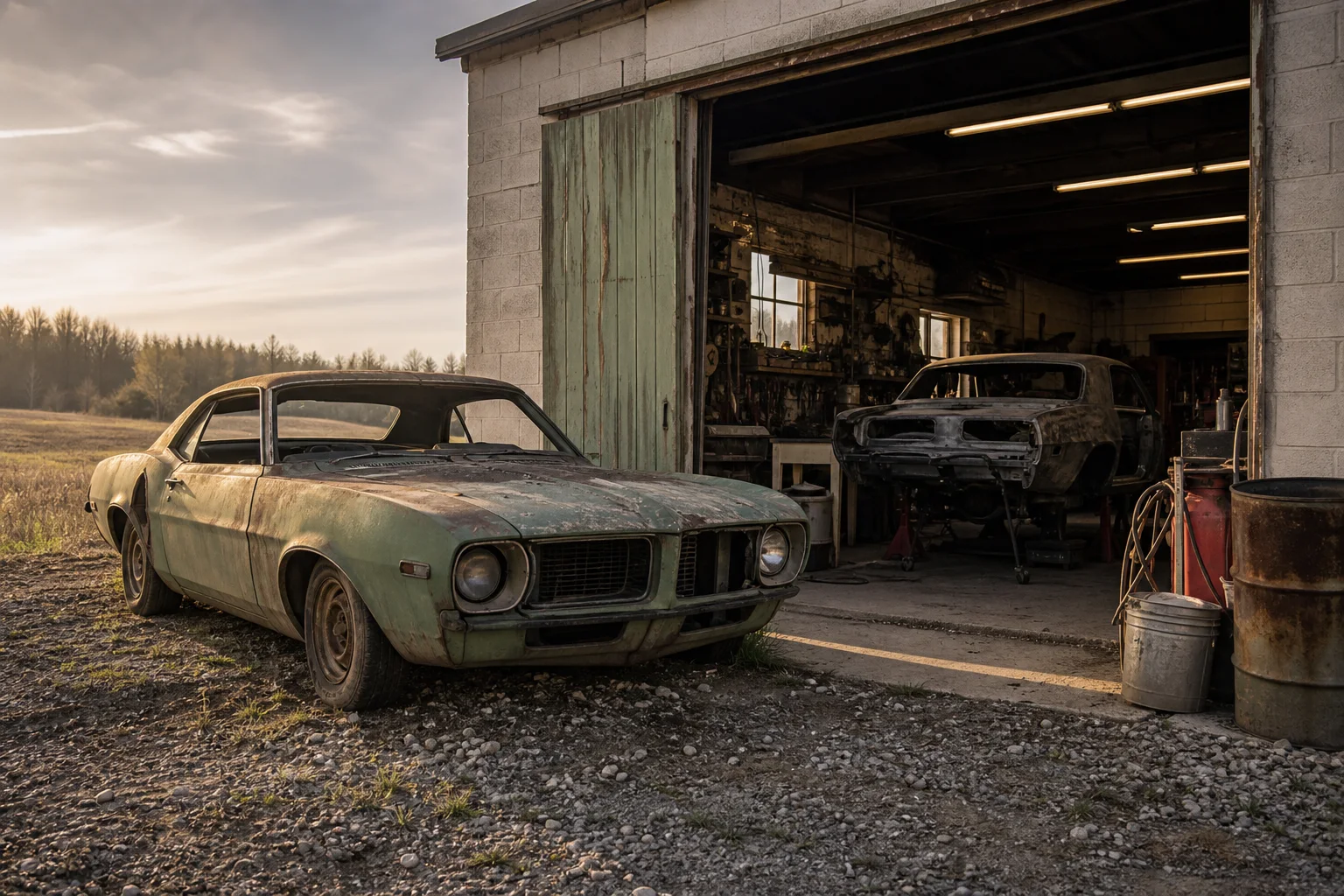
Restoration cost isn’t one number; it’s the intersection of labor hours, finish expectations, and what an outdoor-stored car hides. Here’s a realistic way to budget from ‘sitting outside’ to a full build—without pretending every project is the same.
The quickest way to misunderstand restoration cost is to think in parts lists. The real bill is time: time to uncover what weather and previous repairs hid, time to put back what you took apart, and time to make old panels, old gaps, and old finishes look right again. Start with a car that has been sitting outside and the clock usually accelerates before it slows.
A defensible way to talk about “average” restoration cost is not by naming one number, but by mapping typical outcomes to labor hours and the work categories that reliably eat the budget. At current U.S. shop economics, those outcomes cluster into three bands: a driver-grade revival, a show-quality restoration, and a concours-correct build. Across the trade, published shop-rate discussions commonly land in roughly the $100–$175 per hour range for specialized work, with many independent restoration shops clustering around the middle of that spread. [2] Put that together with the well-known reality that body and paint consume hundreds of hours on any serious job, and a clearer picture emerges: even before rare parts or brightwork enter the chat, labor can exceed the finished value of many cars. [1]
For a car that has been sitting outdoors long enough to be described as a “from sitting outside” candidate, a practical budget range looks like this in 2026 dollars: about $45,000–$100,000 to produce a solid, honest driver; $100,000–$225,000 for a genuinely show-quality restoration; and $200,000–$400,000-plus for concours ambitions, particularly when correctness and finish quality are judged at the level where flaws like orange peel, runs, misalignment, poor plating, or incorrect detailing become point deductions. [8] These are not guarantees, and they are not car-specific quotes. They are the ranges that fall out when typical hours for each restoration level meet typical shop rates, and when the largest cost center—body and paint—does what it always does. [2]
What “sitting outside” actually means to the budget
Outdoor storage changes restoration scope in two ways: it adds corrosion risk in places that are slow to inspect and expensive to fix, and it increases the odds that major systems will need complete teardown rather than targeted repair. The car may look complete, even charming, but water intrusion and long-term UV damage tend to attack the same list of components every time: weatherstrips, glass channels, floor pans, trunk floors, cowl and lower fenders, wiring insulation, interior soft trim, and anything plated.
The hard part is that the first wave of spending often buys little visible progress. Disassembly, cataloging, and evaluation are real labor, and they are the only honest path to a scope you can trust. Hagerty’s restoration guidance highlights the predictable trap: as you get deeper into repair—especially once the car comes apart—you find additional needs you couldn’t see at the outset, and major subprojects like paint or an engine rebuild can exceed the market value of many finished cars. [1]
A useful rule for owners is this: if the car lived outside, budget as though it will need metalwork and a full refinish until proven otherwise. Outdoor cars sometimes surprise you in a good way, but budgets that depend on that surprise usually fail.
Where the money goes: the four big buckets
Restoration invoices differ by marque, era, and parts availability, but the cost structure stays remarkably consistent.
1) Body, rust repair, and paint: the budget’s center of gravity
A restoration-quality finish is not “paint,” it is straightness. Straightness is hours: stripping, metal repair, fitment, repeated priming, guide-coating, and block sanding. Multiple sources aimed at owners and shops describe block sanding as one of the most labor-intensive steps in producing a body that reads flat and true under glossy paint, and they put meaningful hour counts on that step alone. [9] This is why reputable guides emphasize that hundreds of hours in prep can be normal on higher-quality work, and why paint is the line item that owners underestimate most often. [1]
If the target is judged quality, the standard is not personal preference; it is the absence of defects and the correctness of finish and appearance. AACA judging guidance, for example, calls out finish evaluation criteria that include alignment, depth of finish, runs, orange peel, rust, dents, scratches, cracks, lack of paint, and lack of plating. [8] That list is effectively a roadmap for labor.
Practical implication: if the car’s body is fundamentally compromised—rust in structural or hard-to-reach areas, poorly repaired collision damage, missing trim with limited supply—the most cost-effective “restoration decision” can be made before restoration begins: choose a better starting car or narrow the goal to preservation and drivability.
2) Chrome, plating, trim, and brightwork
Brightwork is a silent multiplier. Even when parts are present, they may be pitted, thin, or previously replated poorly. Unlike mechanical work, cosmetic metal finishing doesn’t reward shortcuts. And unlike paint, brightwork cost can spike without warning when a specific piece is scarce or requires specialized repair.
Hagerty’s older collector publication notes the broader trend that high-quality painting and plating costs have been increasing over time, and that restoration totals can become startling even on mainstream cars when you chase high finish quality. [10] The key point is not the age of that observation, but its persistence: plating is still a specialized, regulated process, and good results are priced accordingly.
Practical implication: during early teardown, treat every pot-metal piece, every unique molding, and every emblem as a budget item. If replacement is uncertain, restoration of the original becomes mandatory, not optional.
3) Mechanical systems: engine, transmission, suspension, brakes, cooling, fuel, electrical
Outdoor storage doesn’t just freeze mechanical wear; it adds deterioration. Fuel systems varnish, brake hydraulics corrode internally, cooling passages scale, rubber hardens, and wiring becomes brittle. You can sometimes “wake up” an engine safely, but in professional restorations the question is often not whether it runs, but whether it will be dependable and leak-free after the rest of the car is renewed.
While mechanical work is often more predictable than metal repair, it has its own cost traps: missing original components, machine-shop time, and the temptation to “upgrade while you’re there.” Those upgrades can be worthwhile, but they move the project away from restoration and toward a build, with corresponding scope creep.
Practical implication: decide early whether the mission is authenticity, drivability, or performance. Mixing all three without a clear priority is how a $75,000 plan becomes a $175,000 invoice.
4) Interior, weather equipment, and glass
Sun and moisture attack interiors relentlessly. Seat foam collapses, stitching fails, dash pads crack, carpets rot, and headliners sag. The interior can look “complete” and still be unsalvageable at the level of comfort and finish most owners expect in a finished car.
Interior work is also a sequencing issue. The best shops don’t install finished interior pieces until the car is sealed, wired, and sorted, because restoration is not kind to new upholstery.
Practical implication: if the car sat outside, assume you’ll be paying for weatherstrips, seals, and glass-channel work even if you are not paying for full upholstery. Water control is not a cosmetic choice; it is preservation.
Hours, rates, and why the ranges look the way they do
Shops typically price restoration either by time and materials or by fixed quotes built from estimated hours. Published discussions aimed at owners routinely emphasize shop hours as the only honest backbone for budgeting, with typical independent restoration shop rates often cited in broad ranges that reflect region, specialization, and reputation. [2]
Once you translate restoration level into hours, the “average cost” starts to behave like math. Driver-grade work may land in the hundreds of hours; show-quality pushes into four figures; concours work can run into several thousand hours. [2] That scale is consistent with the reality that high-end paint and body preparation alone can absorb enormous labor, and that the “unknown discoveries” of teardown are routine, not rare. [1]
There’s also a labor-market reality behind those rates. The U.S. Bureau of Labor Statistics puts the median annual wage for automotive body and related repairers at $54,890 (May 2025), a data point that helps explain why a viable restoration business must charge well above wage cost to cover overhead, equipment, materials management, rework risk, insurance, and the long timeline of projects that occupy floor space. [3] Restoration is not priced like an oil change because it is not staffed, tooled, or scheduled like an oil change.
The part owners can control: defining the finish line
The single most effective way to control restoration cost is to define what “done” means in a way a shop can estimate.
Driver-grade, properly sorted
This is not a flip. It is a car that starts, stops, steers, cools, charges, seals reasonably, and presents well at ten feet. The paint may be attractive but not obsessively flat; the interior may be refurbished rather than re-created; the engine bay may be clean and correct-looking without being a reference exhibit.
This level is where the best “outdoor sit” candidates often belong, because it prioritizes stabilization over perfection. It is also the level where owners can make smart compromises: preserve original trim with patina, repair rather than replace some interior components, and avoid chasing microscopic cosmetics that don’t change the driving experience.
Show-quality restoration
This is the level that looks right under bright lights and rewards careful detail work. Panel fit and finish quality become non-negotiable. The parts hunt becomes more serious. And the car’s history begins to matter more, because a show-quality restoration that is visibly incorrect is still visibly incorrect.
Judged restoration and concours aspirations
Concours is where “restoration” becomes documentation and discipline. AACA’s judging materials make clear that finish quality and correctness are evaluated across the vehicle, and that factory documentation governs exceptions. [8] The practical effect is that time goes up: time spent researching finishes and fasteners, time spent finding correct components, time spent redoing work that isn’t quite right.
At this level, a car that sat outside can still be saved, but the budget must reflect the extra metal repair, the additional replacement of weather-affected pieces, and the likelihood that many assemblies will be restored twice—once to test-fit and sort, and again to finish.
Preservation is the underrated option for certain cars
Not every “outside car” deserves a full cosmetic rebirth. Sometimes the best restoration decision is to preserve what remains original and stabilize the car mechanically. That isn’t a philosophical argument; it is an economic and historical one.
AACA’s long-running Historical Preservation of Original Features (HPOF) program exists specifically to recognize and encourage the preservation of original features, and the organization’s own history notes that HPOF was implemented in 1988 and remains a meaningful category within the hobby. [11] That matters because it formalizes a truth many owners learn late: once original material is gone, it’s gone. Paint and interior can be replaced, but originality can’t be recreated—only simulated.
Practical implication: if the car still retains significant original finishes or interior material, the cheapest dollar in restoration can be the one you don’t spend. Clean, conserve, repair, and document before you strip.
How to budget like a professional without turning it into a spreadsheet hobby
A serious restoration estimate should be built around three checkpoints.
First, invest in a teardown-level inspection plan. That doesn’t mean disassembling the entire car before you decide anything. It means agreeing on an initial scope that includes enough disassembly to see the truth: floors, trunk, lower quarters, cowl, frame stress points, body mounts, and evidence of prior repair.
Second, separate work you must outsource from work you can choose to do. Even committed DIY owners commonly farm out machining, paint, and upholstery because the equipment and experience threshold is high. That’s consistent with mainstream restoration guidance that treats body and paint as the least forgiving place for amateur shortcuts. [1]
Third, budget explicitly for the “unknown unknowns.” Hagerty’s restoration guidance is blunt about surprise findings once the project is underway, and outdoor cars have more hiding places for them. [1] The goal isn’t pessimism; it’s schedule and cashflow survival.
A realistic “average cost” statement, with the fine print left in the open
For classic-car owners trying to plan responsibly, the most useful average is this: for a typical classic that has been sitting outside and needs more than simple recommissioning, expect a professional, comprehensive driver-grade restoration to land somewhere around $45,000–$100,000, show-quality to commonly run $100,000–$225,000, and concours-level work to begin around $200,000 and climb, largely as a function of hours and finish expectations. [2] Those numbers move dramatically with rust severity, missing parts, and the standard of bodywork and paint.
Restoration cost is not a single number because restoration is not a single job. It is a long sequence of expensive, skilled decisions, and the outdoor car punishes every decision made too late.
Sources
- What Does It Cost to Restore My Classic Car? — Hagerty
- Hourly vs Fixed Quote: Restoration Shop Labor Rates — ClassicCarsArena.com
- Automotive Body and Glass Repairers: Occupational Outlook Handbook — U.S. Bureau of Labor Statistics
- Hagerty’s Issue 1 (PDF) — Hagerty
- Classic Car Restoration Cost in 2026: Real Budgets — ClassicCarsArena.com
- AACA 2026 Complete Judging Guidelines (PDF) — Antique Automobile Club of America (AACA)
- How to Bookkeep a Classic Car Restoration Shop: Job Costing and WIP Accounting — Beancount.io
- About – AACA — Antique Automobile Club of America (AACA)
- Classic Car Restoration: Costs, Timeline & Finding the Right Shop — WheelPrice
- 2023 AACA Judging Guidelines (PDF) — Antique Automobile Club of America (AACA)
- AACA Policy & Procedure Manual (2024 PDF) — Antique Automobile Club of America (AACA)
AI-assisted research, reviewed and approved by Exclusively Classics.